Greatest Armies, or Units Throughout History...

5fish

Well-Known Member
Joined
Jul 28, 2019
Messages
20,539
Reaction score
6,059
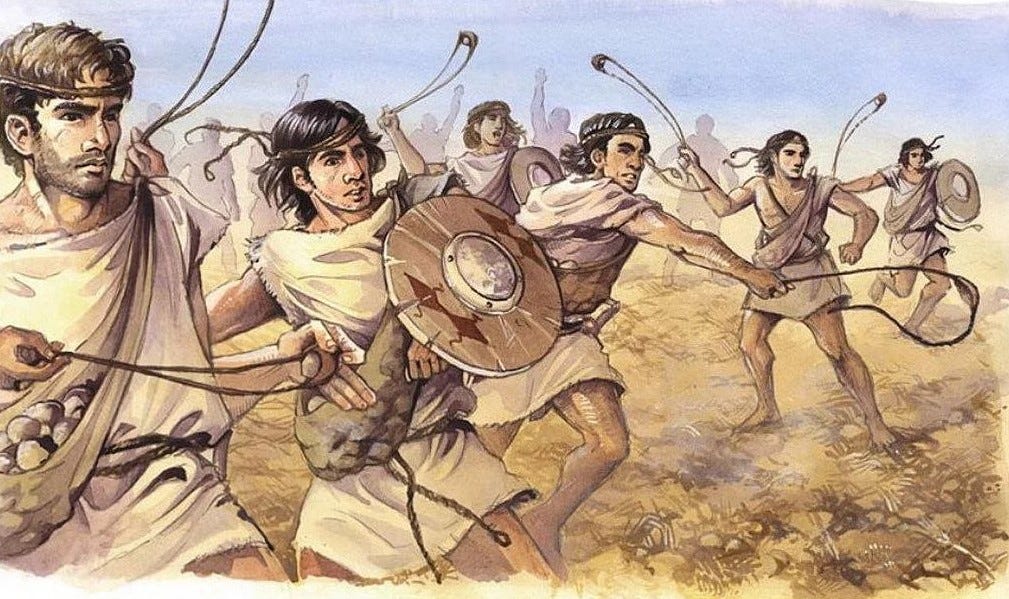
Here is a range unit said to dominate the battlefield. The Balearic Slingers...


snip...

The Balearic slingers launched bullets that had a speed of 160 kilometers per hour (one hundred miles per hour). They could hit their opponents at a distance of 400 meters (1,300 feet) but were deadliest at a distance of 120 meters (400 feet)

snip...

They carried three slings, one round their head, one around their waist, and the third in their hands. Different slings were used to hit targets at different distances. The longer the sling, the larger distance it could cover.

snip...

Some sling bullets had holes to give off a buzzing sound, reminiscent of an agitated wasp. This was an ancient form of psychological warfare. Often, the bullets contained inscriptions and images. The most common were the images of a lightning bolt, a snake, or a scorpion. Some bullets had inscriptions such as: “Take this”, “Catch”, “Ouch”, or “Get pregnant with this.
”

snip...

However, in antiquity, the Balearic Islands were best known for the deadliest slingers in the Mediterranean.The Balearic slingers were a coveted asset of every army of antiquity.

snip...

During the Second Punic War (218-201 BCE), the Carthaginian master general Hannibal wreaked havoc in Roman Italy. He continuously demolished one Roman army after another. Besides Hannibal’s genius, the Numidian cavalry, and battle elephants, the Romans were terrified of the invisible killers — the Balearic slingers
.

snip...

The use of slings slowly faded away. It took years and years of practice to train warriors to efficiently use this weapon. In the Middle Ages, bowmen required less effort to train than slingers. Eventually, bows were replaced by firearms, the usage of which could be taught in a matter of weeks. We could say technology advancement made the Balearic slingers obsolete. However, history will remember them for their skills, terrifying reputation, and admiration from foes and friends alike.

More details...


5fish

Well-Known Member
Joined
Jul 28, 2019
Messages
20,539
Reaction score
6,059
Numidian's were impressive no hands....

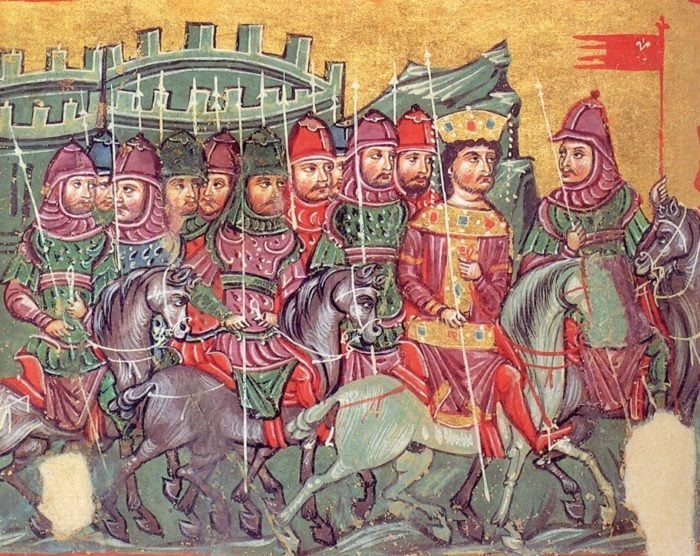
The famed ancient Numidian and Nubian (Kushite) cavalry controlled their horses using just a knotted rope or cord (a cordeo) around the neck combined with profound horsemanship. Relying on leg pressure, body weight, and voice cues, the rope served purely as a gentle backup for turning and stopping. [1, 2, 3, 4, 5]
Their system of "bitless" equitation relied on several key principles: [1]
  • Pressure and Release: The rope was tied loosely around the horse’s neck (or near the sensitive pressure points of the throat). Applying pressure to the right side of the neck signaled the horse to turn left, and vice versa. [1, 2]
  • Leg and Weight Cues: Rather than relying solely on reins, the riders communicated through their posture, shifting weight in the direction they wanted to go, and using their legs against the horse's ribs to guide or prompt speed. [1]
  • Exceptional Horsemanship: Raised in nomadic traditions, Nubians and Numidians began riding at an early age without saddles, stirrups, or bridles. This required riders to develop a high level of balance and an intuitive connection with their mount. [1, 2, 3, 4]
  • The "Berber" Breed: Their horses, ancestors of the modern Berber, were highly agile and naturally responsive to subtle shifts in a rider's balance, making complex equipment largely unnecessary. [1]
In battle, this hands-free approach allowed riders to control the horse with their legs and body while wielding javelins in both hands. [1, 2]

Video ..


5fish

Well-Known Member
Joined
Jul 28, 2019
Messages
20,539
Reaction score
6,059
It seems Nature created a great single menace to Byzantine ships for 50 years... It was a whale that

A giant whale named Porphyrios terrorized the Byzantine Empire in the 6th century, sinking fishing, merchant, and war vessels. Active for over 50 years, the creature is recorded by the historian Procopius. It was likely a rogue sperm whale or a massive orca trapped in the region. The creature was approximately 45 feet long and 15 feet wide, easily capable of ramming and sinking wooden hulls. It plagued the crucial shipping lanes around the Bosporus Strait and Constantinople so relentlessly that Emperor Justinian I ordered its capture


Porphyrios (Greek: Πορφύριος) was a large whale (κῆτος) that harassed and sank ships in the waters near Constantinople in the sixth century. Active for over fifty years, Porphyrios caused great concern for Byzantine seafarers. Emperor Justinian I (r. 527–565) made it an important matter to capture it, though he could not come up with a way to do so. Porphyrios eventually met its end when it beached itself at the mouth of the Sakarya River on the Black Sea and was attacked and cut into pieces by a mob of locals.

When chasing dolphins one day, Porphyrios ran aground near the mouth of the Sakarya River and was beached.[1][14] Though Porphyrios struggled and attempted to get out of the mud, it only managed to sink deeper into the mud, and become more stuck.[4] Locals in the vicinity quickly organized themselves into a mob to kill the famous sea monster, rushing out with axes and ropes.[1][7] They first attempted to kill Porphyrios using their axes, but their cuts into its flesh had little effect.[4] Using ropes and wagons, Porphyrios was then hauled farther up the beach[1] and the whale was attacked and cut into pieces. Some of the attackers stored away their portion of the meat whereas others began to consume it on the spot.


LJMYERS

Well-Known Member
Joined
Sep 2, 2025
Messages
1,735
Reaction score
117
They say the St Clairs of Greensburg PA go back that far. For sure they are hanging around Robin Hood and Prince John.
 

5fish

Well-Known Member
Joined
Jul 28, 2019
Messages
20,539
Reaction score
6,059
What made thd Vikings great was adaptability... and the entrepreneurial spirit... They moved faster than the news...


5fish

Well-Known Member
Joined
Jul 28, 2019
Messages
20,539
Reaction score
6,059
They think they found the site of Alexander the Great's first victory over the Persians... @jgoodguy , @O' Be Joyful , @rittmeister , @LJMYERS

https://www.livescience.com/archaeo...against-ancient-persians-discovered-in-turkey

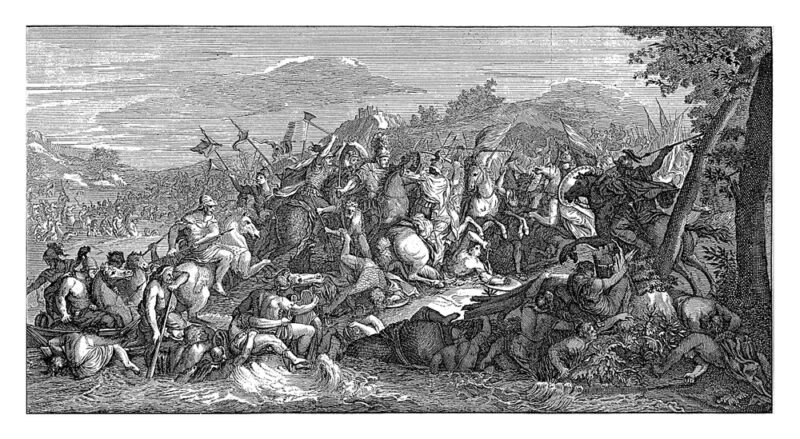
Researchers may have finally identified the site where Alexander the Great fought the Battle of the Granicus against the Persian Empire.

The site is about 6 miles (10 kilometers) north of the city of Biga in northwest Turkey. In 334 B.C. Alexander's forces defeated the Persians at the battlefield, which enabled them to establish a foothold in Persian territory and push deeper into the Middle East.

"The Battle of Granicus was not only one of the most significant turning points in Alexander's life, later earning him the epithet 'the Great,' but [was] also a pivotal moment in world history," team leader Reyhan Körpe, an archaeology professor at Canakkale Onsekiz Mart University, told Live Science in an email.

The Battlefield Discovery

    • Location Found: Researchers led by Turkish archaeologist Reyhan Körpe pinpointed the long-lost battlefield along the Biga River (ancient Granicus River) in northwestern Turkey. [, 2]
    • The Evidence: The team matched ancient topographical records, local encampment remains from the city of Hermaion, and weapons dating back to antiquity. [1, 2]
    • Bones Discovered: Local farmers plowing near a strategic hill—where ancient texts note Alexander stationed opposing Greek mercenaries—uncovered the skeletal remains of an adult male. [1, 2]
    • Grave Status: Archaeologists noted there were no formal grave markers or a collective mass burial pit discovered yet at the spot, meaning further excavation and geophysical surveys are needed to see if more remains lie nearby. [1]
 

LJMYERS

Well-Known Member
Joined
Sep 2, 2025
Messages
1,735
Reaction score
117
I am more into the Jacobite battles. AI says their descendants settled in the Mon Valley of Pittsburgh.
 

5fish

Well-Known Member
Joined
Jul 28, 2019
Messages
20,539
Reaction score
6,059
They found a mass grave from the Battle of Lutzen in 1632, dug it up, and studied it inside a building... The men in the grave were killed by cavalry,,,

the Grave...


The battle...

 
Top